Introduction
If you’ve ever watched a ski jumping event, you’ve probably had the same reaction most people do: “how is it possible for ski jumpers to stay in the air so long and how do they train for that?” It looks like they are defying gravity, almost floating like they belong in a slow-motion sequence rather than real life.
The truth is, the question “how is it possible for ski jumpers to stay in the air so long and how do they train for that?” has a very grounded scientific answer. It comes down to aerodynamics, speed, body position, and years of extremely specialized training that turns athletes into human gliders.
When you really break it down, “how is it possible for ski jumpers to stay in the air so long and how do they train for that?” is not about magic or extreme luck. It is about physics being used in a very precise and controlled way, combined with athletic discipline that most people never see behind the scenes.
The Physics Behind Long Air Time
To understand “how is it possible for ski jumpers to stay in the air so long and how do they train for that?”, you first need to understand the physics of flight. Ski jumpers are not simply falling; they are actively creating lift while moving forward at high speed. Once they leave the ramp, they become aerodynamic objects interacting with airflow in a very intentional way.
One of the biggest reasons behind “how is it possible for ski jumpers to stay in the air so long and how do they train for that?” is the combination of horizontal velocity and lift. Skiers reach extremely high speeds on the in-run, and that forward momentum carries them far beyond the edge of the jump. Instead of dropping straight down, they travel forward in a controlled arc.
Another key factor in “how is it possible for ski jumpers to stay in the air so long and how do they train for that?” is air resistance. By positioning their bodies and skis in a specific way, they increase surface area against the air, which slows their descent and creates a gliding effect. This delicate balance between gravity and lift is what keeps them airborne for several seconds.
Equipment and Aerodynamic Advantages
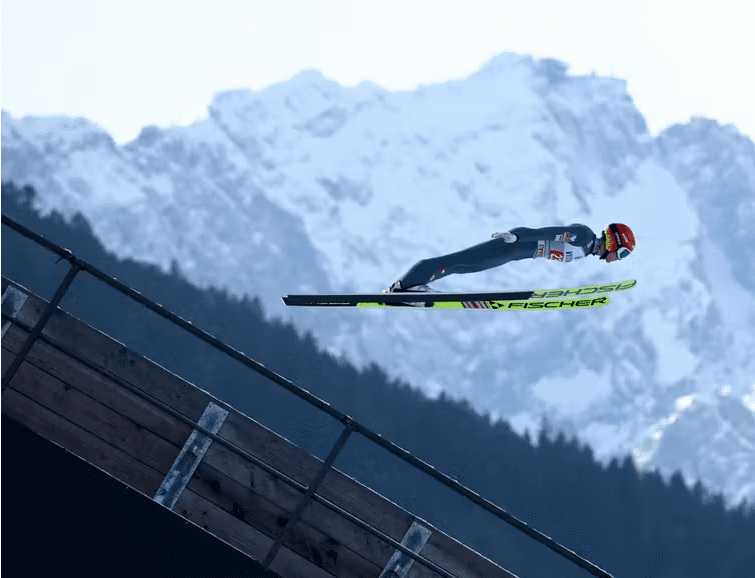
A major part of “how is it possible for ski jumpers to stay in the air so long and how do they train for that?” comes from highly specialized equipment. Ski jumping skis are much longer than regular skis, giving athletes more surface area to generate lift once they are airborne. This design is not accidental; it is carefully regulated for performance and fairness.
The suit design also plays a huge role in “how is it possible for ski jumpers to stay in the air so long and how do they train for that?”. These suits are engineered to interact with airflow in a controlled way. They are slightly loose in certain areas to allow air to fill them, which increases lift, while still being tightly monitored by competition rules.
Even small adjustments in gear contribute to “how is it possible for ski jumpers to stay in the air so long and how do they train for that?”. Binding angles, boot stiffness, and ski positioning all affect how efficiently an athlete can transition from takeoff to flight. Every piece of equipment works together like a carefully tuned system rather than separate parts.
Takeoff Technique and In-Air Control
The takeoff is one of the most critical answers to “how is it possible for ski jumpers to stay in the air so long and how do they train for that?”. At the exact moment the skier leaves the ramp, they must convert forward speed into upward lift. A mistimed movement by even a fraction of a second can reduce distance dramatically.
Once in the air, the answer to “how is it possible for ski jumpers to stay in the air so long and how do they train for that?” lies in body positioning. Skiers immediately adopt the V-style, where skis form a wide angle and the upper body leans forward. This position is the most efficient shape for maximizing lift and minimizing drag.
Control in the air is extremely subtle, which is another reason “how is it possible for ski jumpers to stay in the air so long and how do they train for that?” is so fascinating. Athletes make micro-adjustments using their hips, shoulders, and ankles to stay balanced. These tiny corrections determine stability, direction, and ultimately how far they travel.
Training Methods and Athletic Development
Training is a huge part of “how is it possible for ski jumpers to stay in the air so long and how do they train for that?”. Athletes spend years building explosive strength in their legs because takeoff requires a powerful, precise burst of energy. Without that foundation, achieving proper flight distance would be impossible.
Core strength and balance training are equally important in “how is it possible for ski jumpers to stay in the air so long and how do they train for that?”. Once airborne, the skier must hold a very specific posture against wind pressure. Even small instability in the core can lead to poor aerodynamic positioning.
A large part of “how is it possible for ski jumpers to stay in the air so long and how do they train for that?” also comes from simulation training. Athletes use artificial hills, trampolines, and video analysis systems to refine technique without snow. These tools allow them to repeat movements and correct errors in a controlled environment throughout the year.
Mental Focus and Competitive Pressure
Mental strength is often overlooked in “how is it possible for ski jumpers to stay in the air so long and how do they train for that?”. Athletes must fully commit to each jump without hesitation, because second-guessing at the takeoff point can ruin the entire attempt. Confidence is not optional; it is essential.
Weather awareness is another psychological component of “how is it possible for ski jumpers to stay in the air so long and how do they train for that?”. Wind conditions can change how long a jumper stays in the air, and athletes must adjust instantly to these changes. Reading the air becomes almost instinctive after years of experience.
Competition pressure also shapes “how is it possible for ski jumpers to stay in the air so long and how do they train for that?”. Every jump is scored and compared, meaning athletes must perform consistently under high stakes. This mental resilience is built through repetition, failure, and gradual improvement over time.
Conclusion
Ultimately, “how is it possible for ski jumpers to stay in the air so long and how do they train for that?” comes down to a combination of physics, equipment design, technique, and elite-level training. Ski jumpers are not defying gravity; they are working with it in a highly optimized way.
The sport becomes even more impressive when you realize how precise everything has to be. A slight change in body angle, timing, or wind condition can completely alter the result, which makes consistency incredibly difficult.
So when you watch a ski jumper soaring through the air, remember that “how is it possible for ski jumpers to stay in the air so long and how do they train for that?” is answered not by one factor, but by years of science, discipline, and controlled risk coming together in a single moment.
FAQs
How is it possible for ski jumpers to stay in the air so long and how do they train for that?
It is possible due to speed, aerodynamics, body positioning, and years of specialized training.
Why do ski jumpers lean forward in the air?
Because it helps create lift and reduces air resistance for longer flight distance.
What is the most important skill in ski jumping?
Perfect timing at takeoff combined with stable in-air body control.
Do ski jumpers train year-round?
Yes, they train continuously using snow, plastic hills, and simulation equipment.
How much does equipment affect ski jumping performance?
A great deal, as skis, suits, and bindings all directly impact aerodynamics and lift.
Also read: Jake Webber Height: Everything You Need to Know About His Real Stature
About the Author